
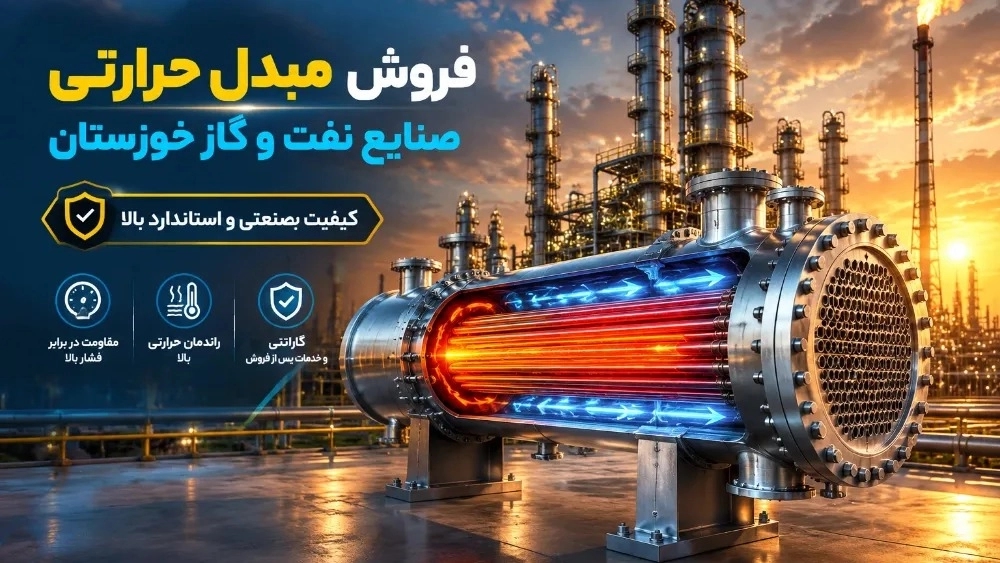
Oil and gas industries are one of the most important economic and industrial sectors of the country, and Khuzestan province has a special place in this field due to its oil fields, refinery facilities, petrochemical complexes and energy transmission infrastructure. The continuous activity of these complexes depends on specialized and reliable equipment, one of the most important of which is the heat exchanger. Sales of heat exchangers in Khuzestan oil and gas industries are very important due to the extensive need of industrial units to control temperature, recover energy and increase the efficiency of processes.
The heat exchanger is a device that is used to transfer heat energy between two fluids with different temperatures. This heat transfer is usually done without direct mixing of two fluids, and in many industrial processes, it plays an important role in maintaining operational conditions, reducing energy consumption and increasing safety.
In the oil and gas industry, heat exchangers are used to heat or cool crude oil, gas, water, process fluids and other materials. The correct selection of this equipment can help to improve the performance of production lines, reduce energy loss and increase the lifespan of other equipment.
Sohail Farjam Energy, in introducing solutions related to industrial and energy equipment, can focus on the importance of basic selection of heat exchanger, checking technical specifications and compatibility of equipment with operational conditions of Khuzestan oil and gas industries. Choosing the right converter should be done according to the type of fluid, working pressure, operating temperature, heat transfer capacity and safety requirements.
What is a heat exchanger and how does it work?
In the simplest case, a hot fluid and a cold fluid move in separate paths and heat is transferred between them through a heat transfer surface. The design of this surface and the flow of fluids affect the amount of heat transfer, pressure drop and the overall efficiency of the device.
In some converters, the fluids move in the opposite direction, which is called counter flow. In some other designs, the flows are co-directional or cross-flow. The selection of the flow arrangement depends on the process conditions, the required temperature difference and the design limitations.
When considering the options of selling heat exchanger in Khuzestan oil and gas industry, it should be determined at what stage of the process the device is going to be used. The converter required for cooling industrial oil may be different in terms of structure and materials from the converter suitable for corrosive fluids or hydrocarbon streams.
For this reason, it is not recommended to buy a heat exchanger based solely on its appearance or nominal capacity. Technical specifications and actual operating conditions should be the basis of selection.
Why is the sale of heat exchanger important in Khuzestan oil and gas industries?
Climatic and operational conditions of Khuzestan
Khuzestan province has hot climatic conditions and many industrial units of this region operate in environments with high air temperature and heavy working conditions. These conditions can affect the performance of cooling systems, cooling towers and heat transfer equipment.
In such an environment, the selection of the heat exchanger should be done according to the ambient temperature, the inlet and outlet fluid temperature, the quality of the cooling fluid and the amount of heat load.
Also, in units that operate continuously, the stability of equipment performance is very important. The correct design of the heat exchanger can help to reduce the problems caused by the increase in temperature and maintain proper operating conditions.
The expansion of oil, gas and petrochemical industries
For this reason, the sale of heat exchangers in Khuzestan oil and gas industries should be accompanied by knowing the real applications of each industry. Choosing the right device for a petrochemical unit may differ from the needs of an oil extraction facility or a gas pressure boosting station.
The importance of reducing stoppage of production lines
Unwanted stoppage of equipment in the oil and gas industry can disrupt the production schedule and increase operating costs. If the heat exchanger is not selected correctly, it may face problems such as deposition, corrosion, leakage or loss of efficiency.
Principle selection of equipment, correct implementation of installation and periodic inspections help to reduce the possibility of such problems. Therefore, checking the quality of construction, repairability and access to spare parts should be considered in the process of choosing a heat exchanger.
Types of heat exchangers used in oil and gas industries
Shell and tube heat exchanger
This type of exchanger is suitable for many industrial applications, including cooling fluids, heating process streams and heat recovery. The shell and tube design allows for use in a wide range of pressures and temperatures; Of course, the permissible range must be determined based on the design and manufacturing specifications of each device.
Among the advantages of this type of converter, we can mention the possibility of designing for different capacities, the ability to be used in various operating conditions, and the possibility of inspection or cleaning in many models.
At the time of buying or checking selling heat exchanger in Khuzestan oil and gas industry, shell and tube exchanger can be one of the important options for processes that require strong industrial equipment suitable for working conditions.
Plate heat exchanger
The plate heat exchanger is made up of a set of plates through which fluids flow in separate channels. The heat transfer surface in this equipment is designed in such a way that the heat exchange is done with proper efficiency.
This type of converter is used in some industrial applications, cooling systems, hot and cold water circuits and processes that require intensive heat transfer.
Screen converters can take up less installation space than some other designs. However, their selection for oil and gas industries depends on pressure, temperature, type of fluid, possibility of clogging and safety requirements.
For fluids with solid particles or special operating conditions, the compatibility of the converter structure with the process should be carefully checked.
Air-cooled heat exchanger
Air-cooled heat exchanger transfers fluid heat to the environment using air flow. In this equipment, the fluid flows inside the pipes, and fans or natural air flow help to dissipate the heat.
This technology is important in some oil facilities, gas processing units and places where access to cooling water is limited.
In Khuzestan province, the ambient temperature conditions must be carefully considered in the design and selection of the air conditioner; Because high air temperature can affect the effective temperature difference and heat dissipation capacity.
Checking the actual capacity at the temperature of the design environment, fan power consumption, heat transfer level and maintenance conditions are important factors in choosing this equipment.
Double pipe heat exchanger
The two-tube exchanger consists of two tube paths, one of the fluids moves in the inner tube and the other fluid moves in the space between the two tubes.
This structure is used in some limited applications, specific capacities and simpler processes. Its main advantage is its relatively simple structure and the possibility of use in situations where heat transfer needs are not very complicated.
However, for large applications and high capacities, dimensions, installation space, pressure drop, and operating costs should be considered to determine whether this type of converter is the right choice.
Application of heat exchanger in oil and gas industries of Khuzestan
Cooling of crude oil and process fluids
In some stages of oil extraction, transportation and processing, fluid temperature control is very important. An increase or decrease in flow temperature can affect the physical properties of the fluid and the performance of downstream equipment.
The heat exchanger helps to regulate the temperature of the fluid by controlled transfer of heat energy. In choosing the equipment used for crude oil, factors such as viscosity, the presence of corrosive substances, the possibility of precipitation and pressure conditions should be checked.
Designing according to these conditions can help reduce operational problems and maintain the stability of the process.
Heat recovery in refineries
In many refinery processes, there are streams that still have usable heat energy after a production step. Using a heat exchanger, part of this energy can be transferred to another stream.
Heat recovery may reduce the need for independent heaters or coolers and improve energy efficiency. The amount of savings depends on the design of the process, the temperature difference of the streams and the operating conditions.
For this reason, in the heat exchanger sales projects in the Khuzestan oil and gas industries, examining the possibility of energy recovery can be a part of the technical evaluation.
Cooling of compressor and turbine equipment
Compressors and turbines are used in many oil and gas facilities to transmit, compress or generate energy. Some parts of this equipment require oil, water or auxiliary fluid cooling systems.
The heat exchanger can keep the temperature of these fluids in the appropriate range and help to maintain the performance of the equipment. The selection of the converter should be done according to the thermal capacity, flow conditions, allowed temperature and the instructions of the main equipment manufacturer.
Temperature control in gas processing units
In gas processing units, temperature regulation is important in different stages. Heat exchangers can be used to cool the gas flow, heat process fluids or create suitable conditions for some separation steps.
The type of converter required depends on the gas composition, operating pressure, flow temperature and process requirements. The presence of corrosive compounds or the possibility of formation of liquids and sediments should also be considered in the design.
Use in petrochemical complexes
In petrochemical complexes, heat exchangers are used in several parts of the production process. Temperature control in chemical reactions, product cooling, feed heating, and energy recovery are among the common uses of this equipment.
According to the difference in petrochemical processes, the selection of the converter should be based on the precise specifications of the fluids and the design conditions. The use of inappropriate material or insufficient heat capacity can affect the performance of the system.
The most important criteria for buying a heat exchanger in Khuzestan
Heat transfer capacity
The heat transfer capacity determines how much heat energy the exchanger can transfer between two fluids under design conditions. This capacity must be in harmony with the real need of the process.
In order to determine the appropriate capacity, information such as fluid flow rate, inlet and outlet temperature, physical properties of fluids and working conditions are checked. Choosing a converter based solely on dimensions or brand, without thermal calculations, can reduce efficiency.
Body material and heat transfer surface
The material used in the construction of the converter must be compatible with the chemical characteristics of the fluids and operating conditions. Carbon steel, stainless steel and some corrosion-resistant alloys may be used in various applications.
Material selection depends on factors such as fluid composition, temperature, pressure, corrosion potential and standard requirements. For environments with corrosive compounds, expert examination of material compatibility is particularly important.
Design pressure and temperature
The heat exchanger must be designed and built for a specific pressure and temperature. Actual operating pressure and temperature, startup and shutdown conditions, and possible process changes should be considered in the design.
Attention to these matters is very important in oil and gas industries; Because the use of inappropriate equipment with working conditions can create safety risks and operational problems.
Pressure drop and energy consumption
The passage of fluids through the internal paths of the converter is accompanied by a pressure drop. If the pressure drop is excessive, pumps or fluid transfer equipment may require more energy.
In choosing the right exchanger, a balance must be established between heat transfer capacity, pressure drop, installation space and operating costs. Basic design can combine proper thermal performance with acceptable energy consumption.
Ability to repair and maintain
Heat exchangers may require inspection, cleaning or repair during the period of operation. Access to heat transfer surfaces, the possibility of replacing parts and the ease of performing periodical services are important factors in choosing equipment.
In the industrial environments of Khuzestan, where many units require continuous activity, proper maintenance can be effective in reducing equipment downtime.
The role of Sohail Farjam Energy in introducing solutions related to heat exchanger
Choosing heat transfer equipment for oil and gas industries requires attention to technical specifications, operational conditions and operational goals. Industrial buyers should check information about capacity, design pressure, operating temperature, material and installation requirements before choosing a product.
Sohail Farajam Energy can emphasize the importance of choosing a heat exchanger according to the needs of oil, gas and petrochemical projects in introducing solutions related to energy and industrial equipment. Providing transparent technical information, introducing the applications of each type of converter and paying attention to engineering criteria are among the topics that help customers make informed decisions.
For accurate product selection, it is necessary to clearly define the needs of the project. Information such as the type of hot and cold fluid, flow rate, inlet and outlet temperature, operating pressure, installation space limitation and environmental conditions can be the basis of technical review.
Also, review of technical documents, construction standards, inspection requirements and quality control documentation should be done according to the sensitivity of the project. In oil and gas industries, verification of equipment compliance with project specifications and applicable standards is particularly important.
The introduction of Sohail Farajam Energy services should be based on the capabilities and real products of this group so that customers can choose the right option for their project with a more detailed understanding of the range of services.
Solutions to increase the life and efficiency of the heat exchanger
Sedimentation control
Deposition is one of the factors that can reduce heat transfer. Minerals in water, suspended particles and some compounds in process fluids may accumulate on heat transfer surfaces.
Controlling the quality of the inlet fluid, using appropriate pretreatment methods and implementing a cleaning program can help reduce this problem. The cleaning method must be compatible with the material of the transducer and the type of deposit.
Corrosion prevention
Corrosion can cause the walls to thin, cause leakage and reduce the safety of the equipment. Choosing the right material, controlling the chemical composition of fluids and monitoring the operating conditions are important solutions for corrosion control.
In sensitive oil and gas applications, periodical inspections and the use of suitable corrosion monitoring methods should be carried out according to the system maintenance program.
Temperature and pressure difference monitoring
Examining the trend of temperature and pressure changes at the inlet and outlet of the converter can provide valuable information about its performance. A gradual decrease in heat transfer or an increase in pressure drop may be a sign of sedimentation, clogging, or a change in process conditions.
Recording and analyzing operational data helps identify potential problems before they become serious failures.
Performing periodic inspections
Regular inspection of connections, accessible surfaces, leakage condition and performance of peripheral equipment is effective in maintaining the working condition of the converter. The type and interval of inspection should be determined based on operating conditions, fluid type and technical instructions.
Performing repairs and services on time can prevent the reduction of efficiency and unwanted stoppage of the process.
Common mistakes when choosing a heat exchanger
One of the common mistakes is choosing a converter based solely on nominal capacity. The actual heat transfer capacity depends on the operating conditions, fluid flow rate, temperature difference and physical properties of the materials.
Ignoring the type of fluid and the possibility of corrosion can also lead to a reduction in the life of the equipment. A transducer that is suitable for clean water is not necessarily a suitable choice for hydrocarbon streams or fluids with corrosive compounds.
Another mistake is neglecting the pressure drop and installation space. Even if the exchanger has a suitable thermal capacity, high pressure drop or difficult repairs can increase operating costs.
Also, lack of complete technical information and unclear design conditions can make the process of selecting and providing equipment difficult. Preparation of detailed technical specifications before purchase is one of the most important measures to reduce these problems.
The future of heat exchanger sales market in Khuzestan oil and gas industries
The development of industrial infrastructure, the need to increase energy efficiency and the importance of reducing stoppages of production lines have increased attention to heat transfer equipment. The oil, gas and petrochemical industries need equipment that is compatible with the actual process conditions to maintain the stability of their performance.
Optimizing heat recovery, using intelligent monitoring systems and improving the design of heat transfer surfaces are among the paths that can improve the performance of thermal systems.
Besides the new technologies, the right choice of material, the design suitable for the fluid, preventive maintenance and the training of manpower are still very important. No equipment can perform optimally throughout its lifetime without proper operation and regular maintenance.
In the heat exchanger sales market in the oil and gas industries of Khuzestan, paying attention to technical specifications, reliability, manufacturing quality, and product compatibility with project conditions can help industrial customers make a more informed choice.
Sohail Farjam Energy can also emphasize the importance of engineering and fundamental selection of heat exchangers by introducing solutions related to industrial equipment and energy efficiency within the framework of its real activities.
summary; Informed choice of heat exchanger for Khuzestan industries
The heat exchanger is one of the important equipments in the oil, gas and petrochemical industries, which is used to control the temperature, recover energy and improve the performance of the processes. The climatic conditions of Khuzestan, the variety of industrial fluids and the need for continuous operation of the facilities have made the selection of this equipment a specialized issue.
For proper selection, the type of exchanger, heat transfer capacity, materials, design pressure and temperature, pressure drop, repairability and maintenance conditions should be checked. Paying attention to these criteria can reduce the possibility of inappropriate selection and help improve the performance of the equipment.
Sohail Farjam Energy can highlight the importance of choosing a heat exchanger suitable for the needs of Khuzestan oil and gas projects in introducing solutions related to energy and industrial equipment. Examining the technical specifications and matching the product with operational conditions is an important step to achieve stable performance and better productivity in industries.