
Water is one of the most important resources needed in various industries, and its quality has a direct effect on the performance of equipment, product quality, maintenance costs, and productivity of production lines. Many factories, production units, food industries, pharmaceutical complexes, power plants and petrochemical units need controlled quality water for their continuous activity. For this reason, the use of efficient solutions in industrial water purification has become one of the important necessities of resource management and increasing efficiency in industrial environments.
Industrial water treatment is a set of physical, chemical and membrane processes that aim to remove pollutants, reduce dissolved solids, control hardness, reduce suspended substances and improve water characteristics. Choosing the right method should be based on the quality of raw water, the type of consumption, the required capacity and the standards of each industry.
In this direction, Sohail Farjam Energy, as a name that is considered in the field of solutions related to energy and industrial processes, can be the focus of introducing specialized services and solutions to optimize processes related to industrial water treatment. Choosing the right equipment, basic design of the system and paying attention to the operating costs are among the issues that are important in the path of achieving an efficient water purification system.
What is industrial water treatment and how is it done?
Industrial water treatment is a set of measures that are carried out to bring water quality to the required level of an industrial process. Water used in industries may come from underground sources, city water, wells, rivers or recycled sources. Each of these sources has different characteristics and may contain suspended particles, dissolved salts, organic compounds, microorganisms or minerals.
In a standard industrial water treatment system, the condition of raw water is checked first. Then, according to the test results, the necessary equipment and steps are selected. In some projects, the use of sand and carbon filters is not enough, and a hardener, reverse osmosis system, or additional technologies should also be used.
The ultimate goal is that the purified water is in harmony with the actual need of the consumer process. For example, the water needed for a cooling tower is not the same as the water used in a boiler or sensitive pharmaceutical industry. Therefore, efficient solutions in industrial water purification must be designed specifically and according to the conditions of each complex.
The most important advantages of industrial water treatment
Increasing the life of industrial equipment
The presence of solutes, hardness and suspended particles in water can cause deposits, corrosion and clogging in equipment. These problems have a significant effect on heat exchangers, pipes, pumps, boilers and cooling systems.
Using the appropriate method of industrial water purification, it is possible to reduce the possibility of sediment formation and the accumulation of pollution. Of course, the selection of the method should be done based on the nature of the water and the type of equipment; Because hardness control alone is not enough to prevent all types of corrosion or sediment.
Reducing maintenance costs
A properly designed industrial water treatment system can prevent some of these problems from occurring. Regular maintenance, basic washing of filters and control of water chemical parameters also play a role in reducing repair costs.
Improving the quality of the final product
In industries such as food production, pharmaceuticals, cosmetics and some chemical processes, water quality may directly affect product quality. The presence of unwanted compounds in water can change the physical or chemical characteristics of the product.
For this reason, industrial water treatment must be designed according to the sensitivity of the process. Controlling the quality of incoming and outgoing water and continuous monitoring of equipment performance helps to maintain production stability.
Better management of water and energy consumption
In a situation where water supply is facing limitations, the management of water consumption and reuse becomes more important. Purification and water recycling of some industrial processes can reduce the dependence on fresh water sources.
Of course, the amount of savings depends on the type of industry, the quality of the incoming water, the technology used, and how the wastewater is managed. Choosing the right solution should be accompanied by technical and economic analysis so that the costs of energy, chemicals and waste disposal are also considered.
The main methods of industrial water purification
sand filtration; The first stage of removing suspended particles
Sand filter is one of the common equipment in many industrial water purification systems. This filter reduces part of suspended particles and water turbidity by passing water through granular beds.
Using sand filtration in pre-treatment can prevent some particles from entering the downstream equipment. This issue is important to protect the finer filters and reduce the possibility of membrane clogging.
However, a sand filter is not designed to remove dissolved salts, completely reduce hardness, or separate all organic compounds. Therefore, in most projects, it should be used along with other equipment based on water analysis.
carbon filter; Improvement of water properties
Carbon filter can reduce some organic compounds, substances that cause odor and taste, and in appropriate conditions, free chlorine by using the property of surface absorption of active carbon.
In industrial water purification systems that use chlorine-sensitive membranes, free chlorine control is particularly important. However, the performance of the carbon filter depends on the carbon quality, operating conditions, contact time and type of pollutant.
Substance replacement or revitalization program, proper washing and output water quality monitoring are measures that should be taken into account to maintain the performance of this filter.
resin hardener; Calcium and magnesium control
Water hardness is usually related to the presence of calcium and magnesium ions. In the right conditions, these ions can cause the formation of mineral deposits in pipes and thermal equipment.
Resin hardener replaces hardener ions with other ions, usually sodium, using an ion exchange process. This method is used in many industrial applications to reduce water hardness.
The important point is that the resin hardener does not remove all the dissolved solutes. Also, the quality of incoming water, resin capacity, amount of water consumption and regeneration time have an effect on the performance of the system.
In projects where hardness reduction is necessary to protect equipment, selecting the appropriate capacity of the hardener and adjusting the regeneration cycle should be part of the industrial water treatment design.
reverse osmosis; Important technology for reducing dissolved solids
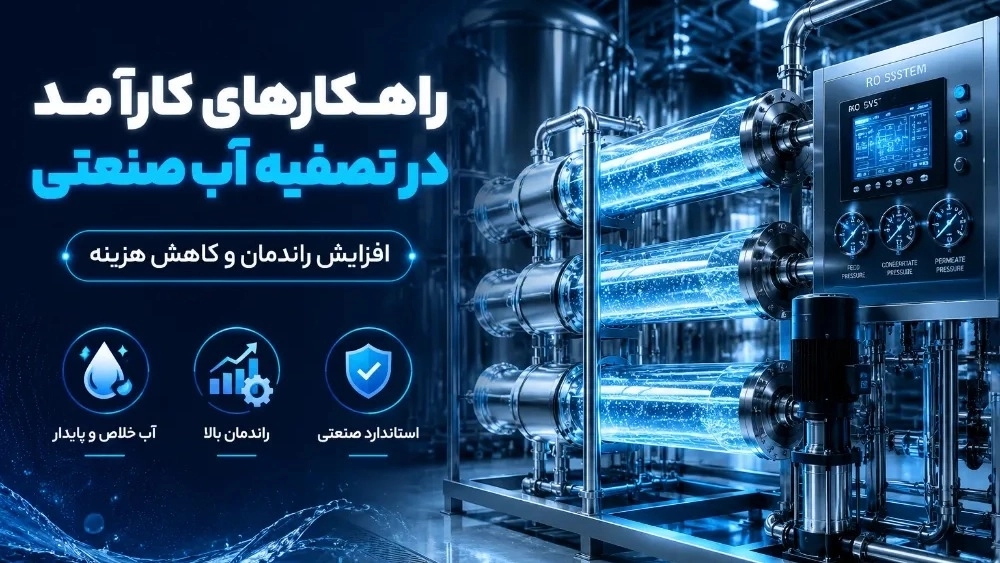
Reverse osmosis or RO is one of the most widely used technologies to reduce salts and many soluble substances in water. In this method, water passes through the semi-permeable membrane using pressure, and most of the dissolved substances remain in the concentrated stream.
Reverse osmosis system is used in various industries, from the production of process water to the supply of water needed for some sensitive equipment. The amount of solute removal depends on the type of membrane, operating pressure, temperature, inlet water quality and design conditions.
To achieve proper performance, pre-treatment is very important. The presence of suspended particles, free chlorine, some organic compounds and sediment-causing substances can damage the membrane or reduce its performance.
Also, in the design of the RO system, the water recovery rate, output water quality, energy consumption, concentrated flow management and membrane washing needs should be considered.
ultrafiltration; Separation of particles and colloidal substances
Ultrafiltration is another membrane technology that is used to separate fine particles, colloidal materials and a large part of microorganisms. This technology can be used as a reverse osmosis pre-treatment step or as part of an independent treatment system.
Ultrafiltration is usually not designed to directly remove dissolved salts. For this reason, in cases where the reduction of electrical conductivity and dissolved solutes is necessary, additional technologies may be needed.
Choosing this method should be done based on the characteristics of the water, the amount of suspended matter and the goals of purification.
Water disinfection with appropriate methods
In some industrial applications, microbial control of water is very important. For this purpose, methods such as ultraviolet radiation, controlled chlorination, or other methods suitable for operating conditions can be used.
The choice of disinfection method depends on the quality of water, the amount of microbial contamination, the duration of water retention and the needs of the process. For example, UV radiation can inactivate microorganisms when properly designed, but unlike some chemical disinfectants, it usually does not produce a residual effect to control contamination in the distribution network.
For this reason, the design of the disinfection step should be done considering the actual conditions of use and health requirements.
How to choose the best industrial water purification method?
Choosing the right method of industrial water purification is one of the most important steps in the implementation of a successful project. Using advanced equipment without examining the real needs of the complex may create unnecessary costs or not bring the output water quality to the expected level.
Detailed analysis of raw water
The first step is to know the characteristics of the incoming water. Water testing can provide important information about hardness, electrical conductivity, dissolved solids, turbidity, pH, alkalinity, silica, iron, manganese and other relevant parameters.
Based on this information, it can be determined which treatment steps are necessary and which equipment should be prioritized.
Determining the required quality of output water
Water quality is not the same for all industries. In some applications, the reduction of turbidity and hardness is sufficient, but in other industries, water with a very low amount of dissolved solids may be needed.
Determining the output water specifications before purchasing the equipment helps to design the system more accurately. This will also prevent the selection of inappropriate capacity or the use of technologies that are not necessary.
Calculate the required capacity of the system
Purification capacity should be determined based on actual water consumption, working hours, consumption during peak activity and future development needs.
The low capacity system may not be able to meet the needs of the production lines. On the other hand, an excessively large design can increase investment costs, energy consumption, and maintenance.
In the basic design of industrial water treatment, the capacity of the equipment must be in harmony with the operating conditions of the complex.
Attention to operating costs
The initial cost of purchasing equipment is only a part of the actual cost of a treatment system. Electricity consumption, chemicals, filter replacement, membrane washing, resin regeneration, manpower and wastewater management should also be checked.
Sometimes a system with a lower initial cost will result in a higher cost in the long run due to the use of more energy or chemicals. For this reason, evaluating the life cycle cost of equipment can help make more accurate decisions.
Efficient solutions to increase the efficiency of industrial water treatment
Basic design of pretreatment steps
Proper pretreatment is one of the most important factors in increasing the life of downstream equipment. Precision filters and reverse osmosis membranes may fail more quickly if particulate matter, chlorine, or fouling agents are not properly controlled.
In a standard system, pretreatment steps should be selected based on water analysis. One project may require sand and carbon filters, while another may require chemical injection, microfiltration, or additional equipment.
Continuous monitoring of operating parameters
Recording information such as the inlet and outlet pressure of filters, water flow rate, electrical conductivity, pH and membrane pressure difference helps to identify problems early.
For example, an increase in pressure difference in a filter can be a sign of particle accumulation. The decrease in reverse osmosis output water quality may also be related to changing operating conditions, membrane damage or pre-treatment problems.
Continuous monitoring allows corrective measures to be taken at the right time and the possibility of unwanted process stoppage is reduced.
Preventive maintenance of equipment
Preventive maintenance includes periodic inspection, timely replacement of filters, control of pumps, check of valves, calibration of measuring equipment and basic washing of membranes.
Doing these actions based on a specific plan can prevent sudden breakdowns. The timing of the services should be determined according to the conditions of the incoming water, the intensity of use and the instructions of the equipment manufacturers.
Management of chemical consumption
Chemicals are used in some stages of industrial water treatment for pH adjustment, sediment control, coagulation, disinfection or equipment washing.
Injecting too much or less than the required amount can disrupt the performance of the system. Therefore, it is very important to choose the type of material, determine the consumption amount and check its compatibility with the equipment.
Using accurate injection equipment and regular monitoring of water conditions helps to optimize the consumption of chemicals.
Using intelligent control systems
In advanced industrial water treatment systems, sensors and controllers can continuously record and analyze operational information. If properly designed, these equipments provide the possibility of automatic control of some valves, pumps, washing cycles and operation steps.
Automation can reduce human errors and make system performance easier to manage. However, the quality of the sensors, the correct adjustment of the controllers and the training of the operators are still essential.
The role of water recycling in different industries
Water recycling is one of the important solutions to reduce pressure on water resources and improve productivity in industrial units. In many factories, part of the used water can be purified and reused after the process.
For example, in some industries, it is possible to reuse wash water, return flows or a part of process effluent after checking the quality and implementing appropriate treatment steps.
Sohail Farjam Energy can be a platform for the audience to learn about the importance of water and energy efficiency in introducing solutions related to optimizing industrial processes and examining resource management options. In each project, the selection of the implementation solution should be done based on the technical review, the actual capacity of the complex and the operational conditions.
Industrial water treatment applications in various industries
Food and beverage industry
In the food industry, water quality can affect the taste, smell, product characteristics and sanitary conditions of production. Depending on the type of product, filtration, activated carbon, hardening, reverse osmosis and disinfection methods may be used.
The design of the system must be in harmony with the health requirements and the characteristics of the final product.
Power plants and boilers
In power plants and steam production systems, hardness and other solids control is very important. Depositing in thermal equipment can reduce heat transfer and increase the risk of equipment damage.
In these applications, the treatment process should be designed according to the working pressure, boiler type and feed water quality requirements. In some cases, the use of reverse osmosis and ion exchange or complementary technologies is necessary.
Pharmaceutical and laboratory industries
In the pharmaceutical industry and some laboratory applications, water must have defined quality characteristics. These specifications may include control of electrical conductivity, total organic carbon, microbial load, and other proprietary parameters.
In these areas, equipment design is only part of the process, and validation, monitoring, documentation and health control are also very important.
Textile and dyeing industries
Water quality in textile processes can affect color absorption, dyeing uniformity and fabric quality. The presence of some metals and salts may change the color or create process problems.
For this reason, choosing the appropriate industrial water treatment method in these industries should be based on the quality of the incoming water, the type of paint and consumables, and the characteristics of the final product.
Chemical and petrochemical industries
In the chemical and petrochemical industries, water may be used for cooling, washing, steam generation or use in specific reactions. Each of these uses requires a different quality of water.
System design should be done considering material compatibility, safety requirements, corrosion control and process quality requirements.
Common mistakes in the implementation of industrial water purification system
One of the common mistakes is to choose equipment without doing a water test. In this situation, the system may not be able to remove the main pollutants or unnecessary costs may be imposed on the complex.
Another mistake is paying attention only to the nominal capacity of the device and ignoring the quality of the output water, recovery rate, energy consumption and maintenance conditions. The nominal capacity alone does not indicate the actual performance of the system in all conditions.
Ignoring pre-treatment can also cause premature clogging of filters and membranes. In addition, the postponement of periodic services, inappropriate use of chemicals, and the lack of a water quality monitoring program are some of the factors that affect the performance of the equipment.
To avoid these problems, it is necessary to carry out all the steps from initial review and design to installation, commissioning and maintenance with a systematic approach.
Why is it important to choose a specialized solution for industrial water treatment?
Each industrial project has special conditions. Differences in water source, production capacity, equipment sensitivity, installation space and final product requirements make it impossible to use the same version for all sets.
Professional solution should start from recognizing the problem and then continue by choosing the right technology, determining the capacity of the equipment and checking the operating costs. Also, the training of operators and the development of a maintenance plan play an important role in maintaining the quality of the output water.
Sohail Farajam Energy can emphasize the importance of engineering solutions, energy consumption management and basic selection of industrial equipment in the introduction content of its services. In order to accurately introduce the services of this group, it is necessary to clearly provide the audience with the range of activities, products, executive records and approved capabilities.
This approach helps customers to pay attention to the support, maintainability and suitability of the solution to their actual needs, in addition to technical specifications, when considering options related to industrial water treatment.
The future of industrial water treatment; Moving towards greater productivity
The development of membrane technologies, increasing the use of smart sensors, improving water recycling methods and paying more attention to energy consumption are important trends in the field of industrial water treatment.
New systems can detect changes in water quality faster using real-time monitoring and data analysis. Also, optimization of operating pressure, sediment control and better design of flow paths can be effective in reducing energy consumption.
However, advanced technology is valuable when it is aligned with the real needs of the industry. In many projects, modification of pre-treatment, proper servicing of equipment and fine-tuning of operating conditions can be as important as the use of new technologies.
The successful future of industrial water treatment depends on a combination of engineering design, resource management, continuous monitoring and manpower training. Collections that consider these factors in an integrated manner will have more opportunity to increase the sustainability of production and better management of resources.
summary
Efficient solutions in industrial water treatment depend on knowing the quality of raw water, determining the output water standard and choosing the appropriate technology. Basic use of sand and carbon filters, hardeners, reverse osmosis systems, ultrafiltration and disinfection methods can help improve water quality and protect equipment.
Besides the choice of technology, continuous monitoring, preventive maintenance, managing the consumption of chemicals and investigating the possibility of water recycling are also very important. Paying attention to these factors can help reduce operational problems, increase equipment life and improve productivity.