
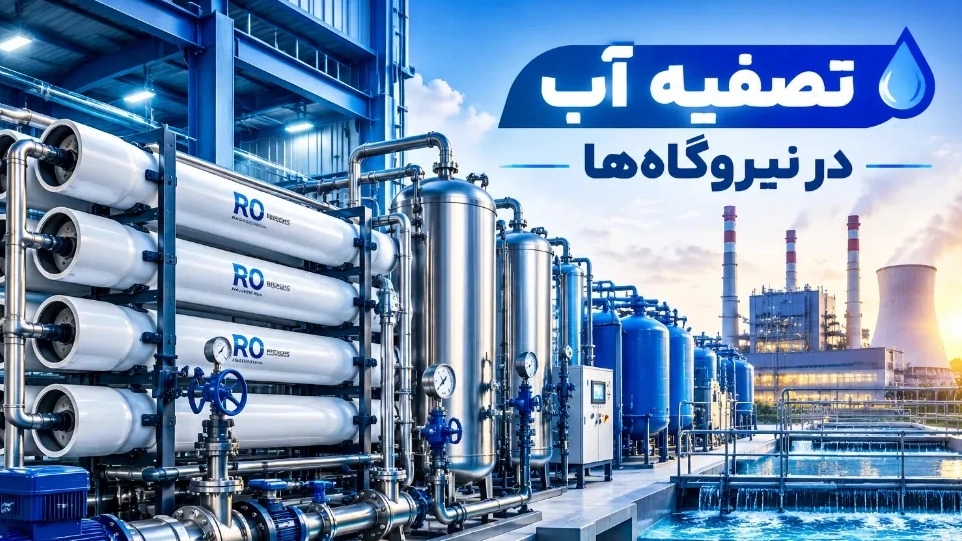
Water is one of the most important resources used in power plant industries and its role is not limited to cooling equipment. From steam production and boiler feeding to equipment cooling, system flushing and control of some side processes, water quality can have a direct impact on equipment performance, longevity and efficiency. For this reason, water treatment in power plants is considered one of the vital parts in the design and operation of thermal power plants, boilers, combined cycles and other energy production complexes.
Raw water that enters the power plant from different sources usually contains solutes, suspended substances, dissolved gases, organic substances, microorganisms and various compounds. The uncontrolled entry of these pollutants into sensitive equipment can cause sedimentation, corrosion, clogging, loss of heat transfer and increase in maintenance costs. For this reason, using a basic system for water treatment in power plants is very important.
In this article, we examine the importance of water treatment, different stages of treatment, equipment used, common methods, operational challenges and the effect of water quality on power plant performance, and then we will discuss the role of Sohail Farjam Energy in providing specialized solutions in the field of energy and related equipment.
What is water treatment in power plants?
Water purification in power plants is a set of physical, chemical and membrane processes that are carried out with the aim of removing or reducing the pollutants in water and bringing its quality to the required level of power plant equipment.
The water used in the power plant needs different quality depending on the type of consumption. For example, the water used in the cooling system may require different specifications than the water used for steam generation. As a result, the design of the purification system should be done based on the type of power plant, production process, quality of raw water and final use of water.
The main purpose of water treatment in power plants is to prevent damage to the equipment and create suitable conditions for the stable operation of the system.
Why is water treatment important in power plants?
Power plants consist of complex and expensive equipment. Boilers, turbines, condensers, heat exchangers, cooling systems and ancillary equipment are all sensitive to poor water quality.
If the water used in this equipment has a large amount of solutes or pollutants, the possibility of sediment formation and corrosion increases. Deposits can accumulate on heat transfer surfaces and reduce heat transfer. On the other hand, corrosion can reduce the thickness of the equipment, cause leakage and even stop part of the process.
For this reason, water treatment in power plants should be considered one of the important measures to increase equipment reliability and reduce maintenance costs.
The most important pollutants in power plant water
Raw water can have different compounds, each of which affects power plant equipment in a different way.
Suspended materials
Suspended particles, mud and solids can clog filters, nozzles, pipes and water transfer equipment.
water hardness
Calcium and magnesium are the main causes of water hardness. An increase in hardness can cause deposits to form in thermal equipment.
silica
Silica is one of the important parameters in steam production systems, and its control in the water entering some equipment is particularly important.
iron and manganese
The presence of iron and manganese can cause deposits, changes in water quality and operational problems in some parts of the system.
Organic matter
Organic substances can affect the performance of purification processes and in some conditions cause microbial growth or the formation of by-products.
Dissolved gases
Dissolved oxygen and carbon dioxide are among the substances that can play a role in corrosion processes.
The main stages of water treatment in power plants
The process of water treatment in power plants usually includes several consecutive steps. Of course, depending on the quality of raw water and the needs of the power plant, the number and type of steps can be different.
1. Water pre-treatment
Pretreatment is the first step to reduce physical pollutants and some substances in raw water. At this stage, equipment such as garbage collectors, sand filters, multilayer filters, and coagulation and flocculation systems are usually used.
The purpose of pre-treatment is to prepare the water for more detailed treatment steps.
2. Filtration
In the filtration stage, suspended particles and some impurities in the water are removed. Choosing the type of filter depends on the quality of the raw water and the required characteristics of the output water.
Sand and multilayer filters are common options at this stage.
3. Hardship
In some projects, hardening is one of the key stages of water treatment in power plants.
4. Reverse osmosis
Reverse osmosis or RO system is one of the important technologies to reduce water soluble solutes. In this method, water passes through the semi-permeable membrane at the right pressure, and a significant part of the salts and dissolved substances are removed.
Using RO can increase the quality of water to enter the additional treatment steps.
5. Additional purification
In applications where high purity water is required, additional technologies such as ion exchange or electrodeionization may be used after reverse osmosis.
Choosing the right method depends on the required water quality and system specifications.
The role of reverse osmosis in water treatment of power plants
Reverse osmosis is one of the most widely used technologies in the water industry and power plants. This technology can separate a significant part of dissolved solutes from water.
In power plants that require high quality water, the use of RO can help reduce the load on additional treatment systems.
Therefore, the correct design of the water treatment chain in power plants is very important.
Boiler water treatment and its importance
One of the most sensitive parts of thermal power plants is the steam production system. The water used in the boiler must have appropriate specifications; Because the presence of solvents and pollutants can cause sedimentation and corrosion.
Precipitation on heat transfer surfaces can reduce heat transfer and increase energy consumption. Also, equipment corrosion can increase the cost of repairs and the risk of stopping production.
For this reason, water treatment in power plants in the boiler section must be designed and controlled with high precision.
What is boiler feed water?
Boiler feed water is the water that enters the steam production system after going through the necessary purification and preparation steps.
The quality of this water must be controlled according to the needs of the boiler and operating conditions. Parameters such as hardness, electrical conductivity, silica, dissolved oxygen and other indicators are important depending on the design of the power plant.
Water purification of the cooling system of the power plant
Cooling systems also consume or circulate a significant amount of water. If water quality is not controlled, sedimentation, corrosion and microbial growth can affect the performance of exchangers, condensers and cooling towers.
In this section, the purpose of water treatment in power plants is not only to produce pure water; Rather, the water quality should be controlled in a range where the equipment can work with proper efficiency and minimal problems.
Based on system conditions, filtration, hardening, chemical control, solids removal systems, and other methods may be used.
The effect of water quality on power plant efficiency
Water quality is directly related to equipment performance. Deposits in exchangers and heat transfer surfaces can reduce heat transfer. When the heat transfer decreases, the system may consume more energy to reach optimal working conditions.
On the other hand, corrosion causes gradual damage to equipment and can reduce their useful life.
Therefore, investing in water treatment in power plants is not only an operational cost; Rather, it can be considered as a measure to increase productivity and reduce long-term costs.
Equipment used in power plant water treatment
A complete water treatment system in power plants can consist of several equipments, including:
- Sand filter
- Carbon filter
- Cartridge filter
- Hardening system
- Reverse osmosis device
- Ion exchange systems
- EDI equipment
- Storage and process tanks
- Transfer pumps
- Chemical injection systems
- Measurement and quality control equipment Water
- control and monitoring systems
The composition of this equipment should be determined based on raw water analysis and the final needs of the power plant.
Corrosion control in power plant systems
Corrosion is one of the important problems in power plant equipment. The constant contact of water with metals, the presence of dissolved oxygen and some chemical compounds can create or intensify corrosion conditions.
Controlling water quality, removing or reducing corrosive agents and using appropriate chemical control methods can help reduce this problem.
For this reason, the water treatment system in power plants should be coordinated with the corrosion control strategy in addition to the removal of solutes.
Sediment control in power plant equipment
Sediment is another common problem in power plant water systems. Compounds such as carbonates and some poorly soluble salts can accumulate on equipment surfaces.
These deposits can reduce the level of heat transfer and increase the pressure drop in some paths.
Appropriate design of the treatment process, hardness control and continuous monitoring of water quality are important measures for sediment control.
Water purification in combined cycle power plants
Combined cycle power plants use a combination of gas turbine and steam turbine to produce energy. In the steam sector, water quality is particularly important; Because steam production and water circulation in this system must be accompanied by strict control of water quality.
In such power plants, the design of the water treatment system in power plants should be done in accordance with the conditions of the steam cycle, the quality of raw water and the needs of the equipment.
Paying attention to water quality can help to increase the stability of the system and reduce the problems caused by sedimentation and corrosion.
The importance of continuous monitoring of water quality
Water treatment is not limited to the installation of equipment. Even if a proper filtration system is designed, water quality must be continuously monitored at different stages.
Measurement of parameters such as electrical conductivity, pH, hardness, silica, dissolved solids and other related indicators can provide important information about the condition of the system.
Regular monitoring allows problems to be detected before they become serious failures.
How to choose a suitable water treatment system for the power plant?
Selecting a water treatment system in power plants should be done with an engineering process. First, the characteristics of raw water should be checked. Then, the needs of each part of the power plant are identified and based on that, the purification process is designed.
The most important information required are:
- Full analysis of raw water
- Required water flow rate
- Type of power plant
- Type of boiler or heating equipment
- Amount of water consumed
- Required quality of outgoing water
- Climatic conditions
- Space available for equipment installation
- Operation and maintenance requirements
By checking these things, you can choose a more suitable solution for the project.
The benefits of basic implementation of water purification in power plants
The correct implementation of the water purification system can have several advantages:
Extending the life of equipment
Decreasing deposits and corrosion makes the equipment work for a longer time in proper conditions.
Reduce the cost of repairs
Water quality control can reduce the possibility of failure due to water problems.
Improve thermal efficiency
Preventing the formation of sediment on the heat transfer surfaces helps to maintain the proper operation of the equipment.
Reduce unwanted stops
Water quality monitoring and control can reduce the possibility of some operational problems.
Better management of water resources
Appropriate design of purification and recycling processes can help more efficient use of water resources.
Sohail Farjam Energy's role in energy and purification solutions
Successful execution of industrial projects requires a detailed understanding of the process, equipment and operating conditions. Sohail Farajam Energy, with its activity in the field of energy and related equipment, can be an option to consider for groups that are looking for specialized solutions in the field of energy systems, cooling and industrial processes.
In projects related to water treatment in power plants, the selection of equipment should be done according to the actual conditions of the complex. The type of raw water, the required capacity, the quality of the output water and the final application all have an effect on the system design.
Cooperation with a group of experts such as Sohail Farajam Energy can help to examine the needs of the project more closely and choose a suitable solution. The main goal should be to design a system that, while achieving the required water quality, is reasonable in terms of operation, maintenance and long-term costs.
summary; Why is water purification in power plants a necessity?
Water purification in power plants is one of the important factors in maintaining the performance of equipment, controlling corrosion and sediment, increasing the useful life of systems and achieving proper efficiency. Improper water can cause problems in different parts of the power plant; From boiler and steam system to condenser, heat exchangers and cooling circuits.
For this reason, a suitable treatment system should be designed based on raw water analysis, plant type, water usage and equipment specifications. The use of technologies such as filtration, hardening, reverse osmosis, ion exchange and other complementary methods can be used according to the needs of the project.
Finally, water treatment in power plants is not a one-time process; Rather, it is a set of engineering design, selection of suitable equipment, quality control, continuous monitoring and basic maintenance. Sohail Farjam Energy can also help with power plant and industrial complexes in the process of examining project needs and choosing solutions related to the field of energy and industrial equipment.