
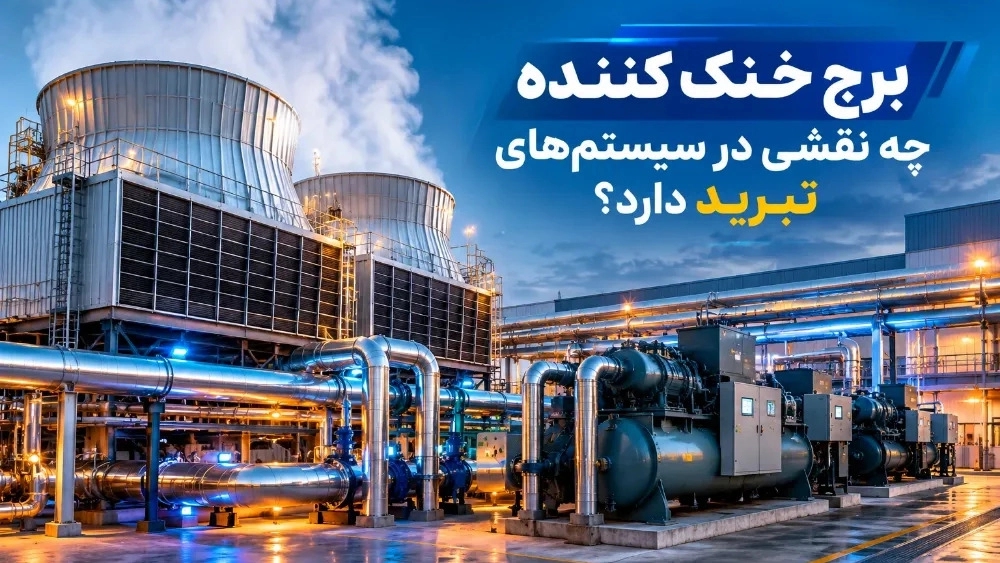
In many industrial, commercial and institutional units, temperature control and heat removal is one of the most important factors to maintain the correct operation of the equipment. Cooling tower is one of the key equipment in this process, which by receiving the heat of water and transferring it to the environment, plays an important role in reducing the temperature of the fluid and preparing it for reuse. For this reason, knowing the role of cooling tower in refrigeration systems is very important to choose the right equipment, increase efficiency and reduce operating costs.
In this article, we will examine the performance of the cooling tower, how it is related to refrigeration systems, its types, advantages, factors affecting efficiency and important points in choosing this equipment, and then we will get to know the services and capabilities of Sohail Farjam Energy.
What is a cooling tower?
Cooling tower is a device used to reduce the temperature of water or fluid used in industrial processes and facilities. In the simplest case, hot water enters the tower and loses some of its heat after coming into contact with the air flow. The cooled water returns to the circuit and can be used to absorb heat.
The basis of cooling tower performance is heat transfer and, in many models, mass transfer between water and air. When hot water is distributed inside the tower, its contact surface with air increases. A part of the water evaporates and carries the latent heat of evaporation with it out of the system. As a result, the temperature of the remaining water decreases.
This simple but effective process has made the cooling tower become one of the important equipment in many cooling and industrial systems.
What is the role of the cooling tower in refrigeration systems?
The most important task of the cooling tower in refrigeration systems is to remove the heat absorbed by the cooling circuit. For example, in a compression refrigeration system, the refrigerant transfers its heat to the environment after passing through the compressor and condenser. In systems that use a water condenser, water plays the role of heat transfer.
After receiving heat, the water is heated and must be cooled again to return to the circuit. This is where the cooling tower comes into play. The hot water is transferred to the tower, cools in contact with the air, and then returns to the condenser.
So we can say:
Refrigeration system → Heat production and transfer → Cooling water → Cooling tower → Heat removal → Cool water return to the circuit
This cycle makes the refrigeration system work continuously.
The importance of heat removal in refrigeration systems
Any cooling system, in addition to producing cold, also produces or absorbs a significant amount of heat. If this heat is not removed from the system, the temperature of various components will increase and the performance of the device will be affected.
Increasing the condenser water temperature can increase the distillation pressure, increase the energy consumption of the compressor and decrease the cooling capacity. As a result, choosing a suitable cooling tower can directly affect the efficiency of the cooling system.
On the other hand, the proper operation of the tower makes the cooling water remain in the appropriate temperature range and the refrigeration equipment withstands less pressure.
How does a cooling tower work?
The operation process of cooling tower can be explained in several steps:
Hot water entering the tower
The water that has received heat from the condenser or industrial equipment enters the upper part or the water distribution system of the tower.
Water distribution
Water is spread on the packings by means of nozzles or distribution systems. The purpose of this step is to increase the contact surface of the weather.
Weather contact
Air enters the tower with the help of a fan or by natural flow. Contact between air and water causes heat transfer.
Evaporation of part of the water
Some of the water is evaporated and heat energy is removed from the circuit. This process is one of the main cooling mechanisms in evaporation towers.
Cooled water outlet
After lowering the temperature, the water collects in the lower part of the tower and is directed to the refrigeration circuit or consumer equipment through the outlet.
Types of cooling towers used in industries
Cooling tower can be divided into different types based on the way of air transfer, structure and contact method of air and water.
Open circuit cooling tower
In this model, process water is directly inside the tower in contact with air. This type of tower is widely used in industries due to its relatively simple structure and proper efficiency.
Closed circuit cooling tower
In a closed circuit tower, the main fluid flows inside a coil and does not come into direct contact with the ambient air. This structure can be a suitable option for applications where fluid quality is more important.
Counterflow cooling tower
In the opposite flow tower, the direction of movement of water and air is opposite to each other. This design allows the effective contact of weather and proper use of the tower space.
Cross flow cooling tower
In the cross flow model, the air passes horizontally through the water flow. Proper access to some components of this type of tower is considered one of its remarkable features.
Cooling tower and chiller connection
One of the most common uses of cooling tower in refrigeration systems is to use it next to cold water chillers. In this system, the chiller is used to produce cold water, and the tower is responsible for removing heat from the condenser side.
In a water-cooled chiller, the heat of the refrigerant is transferred to the water in the condenser. Then the hot water moves to the tower. The cooling tower cools this water and returns it to the condenser.
This cycle reduces the condenser water temperature and provides suitable conditions for chiller operation.
Effect of cooling tower on energy consumption
One of the most important benefits of using a cooling tower properly is helping to manage energy consumption. When the condenser water enters the chiller at the right temperature, the compressor can operate in more favorable conditions.
On the other hand, if the tower capacity is lower than the actual system requirement or the tower is not properly maintained, the water temperature will increase. This issue can increase the working pressure of the equipment and energy consumption.
Therefore, the correct capacity measurement of the cooling tower should be done based on the thermal capacity of the system, weather conditions, water inlet and outlet temperatures, and other operating parameters.
Factors affecting the performance of the cooling tower
The efficiency of a cooling tower depends on various factors. Some of the most important factors are:
Ambient air temperature
The higher the ambient temperature, the more difficult the cooling conditions. For this reason, the design of the tower should be done based on the climatic conditions of the installation site.
Relative humidity of the air
Air humidity affects the power of water evaporation. Dry air usually has a greater capacity to receive moisture and can contribute more to the evaporative cooling process.
Water quality
The presence of sediment, salts and pollution in water can reduce the performance of nozzles, packings and other components of the tower.
Packing status
Packing is one of the important components of the tower that increases the contact surface of water and air. Clogged or damaged packing can reduce the cooling efficiency.
Fan operation
In mechanical towers, the fan plays an important role in creating air flow. Reducing the performance of the fan can directly affect the heat transfer capacity.
Why is it important to choose the right cooling tower?
Choosing a cooling tower is not based on nominal capacity alone. To make the right choice, a set of technical factors must be checked.
The thermal capacity of the system, water flow rate, incoming hot water temperature, outgoing cold water temperature, bubble temperature of the environment, installation conditions, space limitation and type of application are among the important things in choosing a tower.
If the tower is chosen smaller than the system needs, it will not have the necessary ability to dissipate heat. On the other hand, choosing a much higher capacity can also increase the initial cost and side costs of the system.
For this reason, it is very important to get expert advice before purchasing or designing a cooling tower.
Cooling tower applications
The use of cooling tower is not limited to refrigeration systems. These equipments are used in different industries and collections; Including:
- Power plants
- Petrochemical industries
- Refineries
- Manufacturing plants
- Steel industries
- Food industries
- Air conditioning systems
- Large buildings and commercial complexes
- Cool water chiller systems
- Industrial processes requiring disposal Heat
In all these applications, the main goal is to control the water temperature and transfer excess heat to the environment.
Advantages of using cooling tower in refrigeration system
Using a suitable cooling tower can provide various benefits to the refrigeration system.
Increase system efficiency
By reducing the condenser water temperature properly, the working conditions of the cooling equipment will improve.
Reducing the working pressure of equipment
The proper operation of the tower can prevent the condenser temperature from increasing too much.
Help reduce energy consumption
When the system operates in optimal thermal conditions, it becomes possible to manage energy consumption better.
The possibility of water reuse
After cooling, the water re-enters the cycle and if managed properly, the need for continuous water supply is reduced.
Increased performance stability
A suitable tower can help maintain stable thermal conditions in the circuit and prevent extreme temperature fluctuations.
Maintenance of cooling tower
Regular maintenance is an important part of operating a cooling tower. Even the best equipment cannot perform optimally in the long term without proper service and control.
Checking nozzles, cleaning packing, controlling fan and motor, checking vibration, checking water quality, checking leaks, and checking electrical equipment are some of the actions that should be done periodically.
It is also necessary to check the amount of sedimentation and corrosion. Accumulation of sediment can reduce the level of heat transfer and limit the path of water flow.
Common problems in cooling tower operation
Sometimes the reduction of cooling tower efficiency occurs for reasons such as clogged nozzles, fan failure, improper water distribution, packing contamination, reduced air flow, or poor water quality.
One of the important signs of a problem is an abnormal increase in the temperature of the water coming out of the tower. Of course, to accurately diagnose the cause, the conditions of the entire system, including pumps, piping, heat exchanger and refrigeration equipment, must also be checked.
The difference between suitable cooling tower and non-standard equipment
A suitable cooling tower should be designed or selected based on the actual project conditions. The use of inappropriate equipment may initially reduce the cost of purchase, but in the long run, it will increase energy consumption, reduce cooling capacity, and increase the cost of repairs.
Construction quality, selection of suitable material, correct design of water distribution system, fan performance, type of packing and proper access for repairs are important factors in the quality of a tower.
Why seek help from experts to choose a cooling tower?
Choosing cooling equipment is not a purely commercial decision and has a purely technical aspect. The smallest mistake in capacity estimation can affect the performance of the entire system.
Sohail Farajam Energy, focusing on solutions in the field of energy and equipment related to cooling and industrial systems, can be a viable option for industrial and institutional complexes in the way of selecting and supplying equipment according to the needs of the project.
When choosing a cooling tower, it is better to check the project specifications, thermal capacity, climatic conditions and how to use the equipment by an expert so that the final product is in harmony with the real needs of the complex.
Buying a cooling tower with an informed choice
Before buying cooling tower, factors such as capacity, tower type, body material, fan type, packing quality, amount of circulating water, weather conditions and installation method should be considered.
Also, the purchase cost is not the only decision criterion. The cost of energy, maintenance, supply of parts, periodical service and the life of the equipment should also be considered.
The right choice can control operating costs and keep the performance of the refrigeration system at an optimal level.
Sohail Farjam Energy; Your companion in choosing cooling equipment
For collections that are looking for suitable solutions in the field of energy equipment, cooling and industrial systems, cooperation with an expert collection can simplify the equipment selection process.
Sohail Farajam Energy can be with customers on the way to choose the right solution for cooling systems and related equipment by examining the needs of the project and working conditions. The goal of this process is to reach a solution that, in addition to proper performance, is also justified in terms of operation and maintenance costs.
If you need a cooling tower for your industrial, commercial or institutional project, it is better to carefully check the required capacity and technical specifications of the system before purchasing. The engineered selection of equipment is one of the most important steps to achieve a stable, low-consumption and reliable refrigeration system.
summary
Cooling tower is one of the important components in many refrigeration systems and industrial processes, and its main task is to remove heat from water and return cool water to the circuit. The correct operation of this equipment can have a direct effect on chiller efficiency, energy consumption, equipment working pressure and system stability.
Choosing cooling tower should be done according to thermal capacity, climatic conditions, water temperature, flow rate and type of application. Also, periodic maintenance, water quality control and service of various components are necessary to maintain efficiency.
In this way, Sohail Farjam Energy can be an active group in the field of energy and cooling equipment and solutions, a suitable option to check the needs of the project and choose the appropriate solution.