
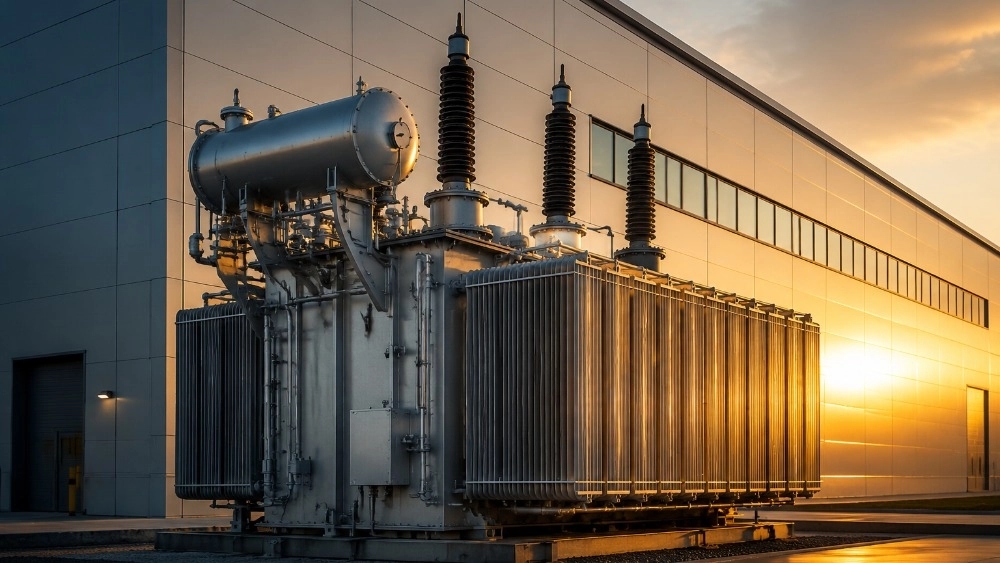
Choosing the best transformer for factories is one of the most important decisions faced by industrial managers, electrical engineers and maintenance officials. In every production unit, from food and pharmaceutical industries to steel, cement, petrochemical and textile factories, the transformer plays a vital role in energy stability, equipment safety and production process continuity. If this choice is not done correctly, the result can be increased operating costs, stopping the production line, reducing the life of equipment, and even causing serious damage to the factory's internal power network.
For this reason, choosing the best transformer for factories does not just mean buying an electrical equipment; Rather, it is a strategic investment to maintain productivity, reduce risk and ensure the sustainable development of the industrial complex. Many factories realize the importance of this issue when they are faced with voltage drops, overloads, overheating of equipment or frequent breakdowns. In such a situation, the cost of correcting mistakes will be much higher than the cost of a principled choice in the beginning.
On the way to choose the best transformer for factories, a set of technical, environmental, economic and operational factors should be examined together. Required power, type of load, installation conditions, energy efficiency, insulation level, build quality, reliability and technical service after delivery, all have a direct effect on this decision. Also, cooperation with an expert and committed group like Sohail Farajam Energy can make this route more accurate, faster and more reliable for factories.
Why is it important to choose a transformer in factories?
In industrial environments, electricity is not just a simple energy source, but the main pillar of the production process. Any disruption in electricity supply can cause machinery to stop, product quality to decrease, production capacity to decrease, and heavy financial damages to be imposed. For this reason, choosing the best transformer for factories should be done with a professional and forward-looking perspective.
The right transformer can distribute electricity in a stable, safe and optimal way. On the other hand, an improper transformer may cause increased energy losses, voltage fluctuations, and excessive stress on electrical equipment. In many industries, electrical loads are constantly changing and this increases the selection sensitivity. For example, starting large electric motors, industrial furnaces, compressors, automation lines and CNC machines requires accurate network design and correct transformer selection.
Therefore, choosing the best transformer for factories not only helps the factory's performance today, but also has a direct impact on capacity development, failure reduction and cost management in the years to come.
What is an industrial transformer and what is its role in the factory?
Industrial transformer is a device that transfers electrical energy between different voltage levels in order to supply electricity needed by different parts of the factory with safety and quality. This equipment is installed in the power input of the factory or in internal distribution sections, and its task is to adjust the voltage according to the needs of consumers.
In the discussion of choosing the best transformer for factories, it should be noted that the transformer is not just an energy transfer agent. In practice, this equipment helps the stability of the internal network, equipment protection, loss control and increasing the reliability of the entire system. If the capacity, type and performance class of the transformer are not aligned with the actual needs of the factory, the entire internal network will be affected.
The most important criteria in choosing the best transformer for factories
1. Accurate determination of the power consumption of the factory
The first and most important step in choosing the best transformer for factories is to correctly estimate the electrical load. This calculation should be done based on the sum of permanent loads, momentary loads, simultaneity factor, power factor and the future development plan of the factory. Choosing a transformer with a smaller capacity than needed will cause overload and increase in temperature, and choosing too large will increase the investment cost and no-load losses.
To reach an accurate result, motor loads, lighting, ventilation systems, control equipment, furnaces, pumps and production lines need to be checked individually. At this stage, the presence of an expert team like Sohail Farjam Energy can prevent calculation errors and costly decisions.
2. Knowing the type of load and consumption behavior
All factories do not have the same consumption pattern. Some units have a uniform load and others face sudden peaks. In choosing the best transformer for factories, it should be determined that the dominant load is motor, resistive, induction, electronic or combined. The presence of harmonics, heavy startups and extreme consumption fluctuations can affect the design and selection.
In factories where sensitive electronic equipment or variable frequency drives are used a lot, checking the power quality and transformer resistance against nonlinear conditions becomes more important.
3. Choosing the right voltage level
Another important principle in choosing the best transformer for factories is determining the primary and secondary voltage levels based on the structure of the regional power grid and the internal needs of the factory. This should be coordinated with switchboards, cables, protective equipment and end consumers. Any inconsistency in this section can disrupt the performance of the entire network.
4. Attention to efficiency and energy losses
Factories are big consumers of electricity, and even a small percentage of losses over time can turn into a significant cost. For this reason, choosing the best transformer for factories should be done according to the actual efficiency of the equipment in working conditions. Transformers with optimal design and high-quality raw materials have lower no-load losses and load losses and create more economic savings in the long run.
5. Checking the environmental conditions of the installation site
The factory environment is not always ideal. High heat, humidity, dust, corrosive gases, vibration, limited space and installation height all affect the performance of the transformer. As a result, choosing the best transformer for factories will not be complete without careful consideration of environmental conditions. Sometimes it is necessary to choose the type of cooling system, insulation class or even body structure according to the environment.
oil or dry transformer; Which option is better for the factory?
One of the important technical questions in choosing the best transformer for factories is choosing between oil and dry transformer. Each of these two types has its own advantages and limitations, and the final choice should be made based on the type of industry, installation location, and safety requirements.
Oil transformer
Oil transformers are very common in industrial projects due to their high power, proper cooling and wide application. This type of transformer is considered a safe option for many large factories. In projects where open space is available and standard maintenance conditions exist, this model can perform very well.
Dry transformer
Dry transformers are mostly used in closed spaces, indoor environments and places with high safety sensitivity. In factories where there are specific restrictions on the use of oil or where ventilation and fire safety are more important, this type of equipment can be a more suitable choice.
Finally, to choose the best transformer for factories, the advantages and limitations of both options should be adapted to the actual conditions of the project. Sohail Farjam Energy can play an effective role in this technical decision by accurately evaluating the needs of the factory.
The role of manufacturing quality in long-term transformer performance
One of the common mistakes in industrial projects is focusing only on buying equipment and ignoring the quality of construction. While choosing the best transformer for factories without considering the quality of the core, winding, insulation system, connections, tap changer and production standards will be an incomplete choice.
A transformer made with poor raw materials or unengineered design may show acceptable performance in the initial months, but in the medium term it will face problems such as increased noise, loss of efficiency, abnormal heating and reduced useful life. For this reason, it is very important to cooperate with a group that has an engineering approach, quality control and a real understanding of the industry's needs.
Sohail Farjam Energy, relying on its specialized experience and technical approach to industrial projects, guides the path of choosing the best transformer for factories based on quality, reliability and efficiency.
Importance of standards and technical requirements
In the process of choosing the best transformer for factories, valid technical standards and safety requirements must be fully respected. These standards are not just a formality, but a framework to guarantee the performance, safety and durability of the equipment. Specifications related to thermal tolerance, insulation strength, losses, noise, factory tests and operating conditions should all be carefully checked.
Factories that seek sustainable development usually choose equipment that is technically aligned with today's and tomorrow's complex needs. This professional look reduces the possibility of rework and early replacement of equipment.
Why is foresight necessary in choosing a transformer?
Many factories are developing production lines, increasing capacity or adding new equipment. If the selection of the best transformer for factories is done only based on the current need, it may not respond to the new load in a short time. This issue causes the factory to enter the costs of design, purchase and installation again.
Foresight does not mean always choosing the biggest transformer possible, but considering possible development, production growth, load type changes and long-term portfolio strategy. The right decision is a decision that both covers the current need and is flexible for the logical development of the factory.
The effect of choosing the right transformer on reducing factory costs
Perhaps at first glance, managers focus only on the purchase cost, but the fact is that choosing the best transformer for factories affects hidden and long-term costs more than anything else. Energy losses, frequent repairs, production stoppages, downstream equipment failures and higher electricity consumption can all result from a wrong choice.
The right transformer helps the factory to:
- Increase energy efficiency.
- Maintain the stability of production lines.
- Reduce the risk of sudden failure.
- Extend the life of electrical equipment.
- Control maintenance costs.
For this reason, choosing the best transformer for factories is not an expense, but an economic and intelligent action to maintain the profitability of the complex.
Specialized services of Sohail Farjam Energy in the selection of transformers
When it comes to choosing the best transformer for factories, experience and expertise play a decisive role. Many bad decisions occur when choices are made based on incomplete information, superficial comparisons, or a purely shopping-oriented view. On the other hand, a group like Sohail Farjam Energy with a specialized and industrial approach can turn this process into a reliable engineering decision.
The strength of Sohail Farjam Energy is that its view is not limited to the sale of an equipment, but is focused on providing a solution that fits the reality of the project. Such a view is an important advantage for factories that seek quality, sustainability and risk reduction.
Common mistakes in choosing an industrial transformer
In order to successfully choose the best transformer for factories, some common mistakes should be avoided:
Selection based on nominal capacity only
Some think that the only criterion is the capacity number; While the type of load, environmental conditions and consumption pattern are equally important.
Ignoring future development
A factory that has a growth plan should include this issue in the electrical design and equipment selection from the beginning.
Ignoring efficiency
Focusing only on the initial purchase and ignoring energy losses will result in higher costs in the long run.
Selection without expert advice
In industrial projects, professional technical advice can avoid costly mistakes. For this reason, the presence of a group like Sohail Farajam Energy in the decision-making process is a valuable advantage.
summary
Choosing the best transformer for factories is a highly specialized, multidimensional process that affects the future of the factory. This choice should be made based on power consumption, type of load, environmental conditions, efficiency, construction quality, technical standards and development plan of the complex. Any hasty or unprofessional decision in this field can cause significant direct and indirect damages.
Factories that care about production stability, reducing energy costs, increasing equipment life and preventing sudden stops should consider choosing the best transformer for factories as a strategic priority. In this direction, benefiting from the experience, technical knowledge and engineering perspective of a reputable group plays a very important role.
Sohail Farjam Energy, with its specialized and committed approach, is a reliable companion for industries and factories that want to make an accurate, principled and forward-looking choice. If the goal is to provide stable, safe and optimal electricity for an industrial unit, cooperation with a group like Sohail Farajam Energy can make the decision-making process smarter and the final result more reliable.